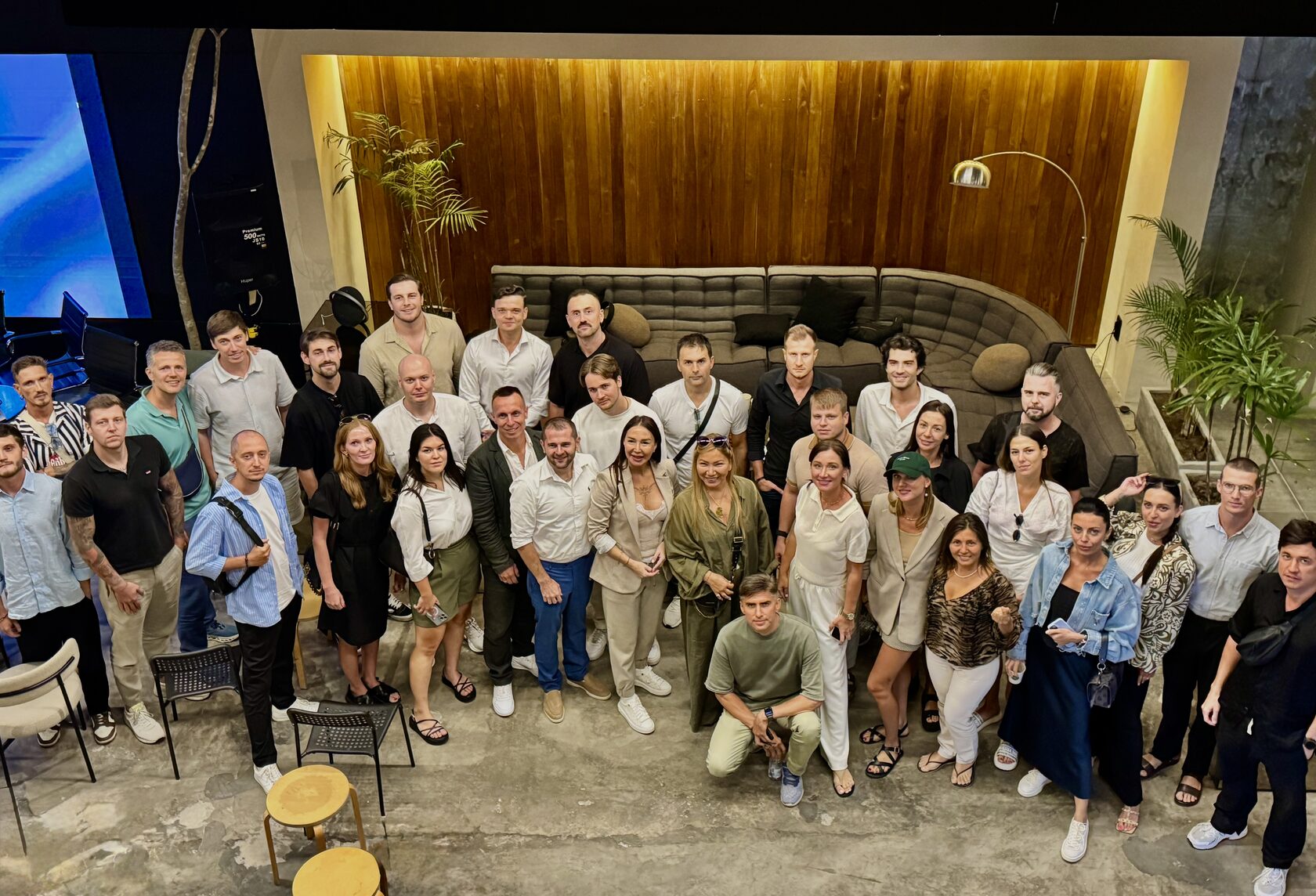
Recently, as part of the Legacy business club, a round table was held that gathered dozens of market participants in a large hall. At the main table six experts met — three developers and three brokers, and colleagues who could not only observe but actively participate in the discussion were present in the hall.
The meeting was moderated by Olga Gorkhiyan herself, founder of Global Investment Property and the Legacy business club. She set the direction of the discussion and helped participants identify the key challenges that the Bali real estate market is facing today.
The main goal of the meeting was for brokers and developers to hear each other directly. This is especially relevant for Bali: developers often face misunderstanding from brokers, and brokers, in turn, need greater project transparency.
What challenges developers face
One of the central issues was the financial and legal sustainability of projects. Participants noted the risks of unfinished construction and dependence on early-stage sales. The solution was regular audits and attraction of alternative sources of financing.
No less attention was paid to product quality. Often the project does not meet buyers' expectations, which directly affects sales. Here developers were advised to use a product audit from the market — including in the format of closed project reviews at Legacy.
The third topic was understanding the end consumer. Sometimes a project is created without a clear concept and segment analysis, which reduces profitability. The solution is pre-development and forming a product that addresses a specific shortage.
The financial model of projects was also discussed. Saving on quality or incorrect calculations lead to the risk of unfinished construction. The proposed solution was to adjust financial models together with club experts and implement transparent budgeting.
What brokers pay attention to
For brokers the key problem was the lack of skills to evaluate projects. Without checking financial and legal sustainability they risk selling "scam" objects and undermining their own reputation. The solution was systematic training and the introduction of standards for project verification.
Separately, the topic of ROI was discussed. Brokers often promise investors too high a return, not taking into account the real profitability of the market. Here analytics and working with cases that form a sober understanding of expected profit are needed.
The secondary market was also touched upon. Sales of finished properties remain at a low level, and brokers need new tools to work in this segment.
And, of course, an important issue is interaction with the developer. Without built business processes leads are lost and conversion into deals decreases. At the round table it was proposed to implement unified standards of joint work that will help both parties move more effectively toward the result.
Meeting results
The round table showed: developers and brokers have different roles, but common tasks. For the Bali real estate market to develop, quality interaction, transparent processes and joint work on the product are necessary.
Such meetings become an important platform for exchanging experience and finding solutions that make the market more mature and sustainable.
The meeting was moderated by Olga Gorkhiyan herself, founder of Global Investment Property and the Legacy business club. She set the direction of the discussion and helped participants identify the key challenges that the Bali real estate market is facing today.
The main goal of the meeting was for brokers and developers to hear each other directly. This is especially relevant for Bali: developers often face misunderstanding from brokers, and brokers, in turn, need greater project transparency.
What challenges developers face
One of the central issues was the financial and legal sustainability of projects. Participants noted the risks of unfinished construction and dependence on early-stage sales. The solution was regular audits and attraction of alternative sources of financing.
No less attention was paid to product quality. Often the project does not meet buyers' expectations, which directly affects sales. Here developers were advised to use a product audit from the market — including in the format of closed project reviews at Legacy.
The third topic was understanding the end consumer. Sometimes a project is created without a clear concept and segment analysis, which reduces profitability. The solution is pre-development and forming a product that addresses a specific shortage.
The financial model of projects was also discussed. Saving on quality or incorrect calculations lead to the risk of unfinished construction. The proposed solution was to adjust financial models together with club experts and implement transparent budgeting.
What brokers pay attention to
For brokers the key problem was the lack of skills to evaluate projects. Without checking financial and legal sustainability they risk selling "scam" objects and undermining their own reputation. The solution was systematic training and the introduction of standards for project verification.
Separately, the topic of ROI was discussed. Brokers often promise investors too high a return, not taking into account the real profitability of the market. Here analytics and working with cases that form a sober understanding of expected profit are needed.
The secondary market was also touched upon. Sales of finished properties remain at a low level, and brokers need new tools to work in this segment.
And, of course, an important issue is interaction with the developer. Without built business processes leads are lost and conversion into deals decreases. At the round table it was proposed to implement unified standards of joint work that will help both parties move more effectively toward the result.
Meeting results
The round table showed: developers and brokers have different roles, but common tasks. For the Bali real estate market to develop, quality interaction, transparent processes and joint work on the product are necessary.
Such meetings become an important platform for exchanging experience and finding solutions that make the market more mature and sustainable.